
Maui trip guide · checked November 2026
Maui Trip Guide: A 5-Day Nature Itinerary
Five days is enough to see the best of Maui’s wild side: humpback whales and sea turtles off Lahaina, sunrise above the clouds on Haleakalā, waterfalls on the Road to Hana, and reefs full of fish in South Maui. This guide is written by the crew at Ultimate Whale Watch & Snorkel, locally owned and operated in Lahaina since 1982. It is the plan we give our own friends and family.
The short answer: spend Day 1 settling in on the West side, Day 2 on the water (a whale watch from December into spring, or a Lanai snorkel and dolphin trip any time of year), Day 3 at Haleakalā for sunrise and Upcountry, Day 4 on the Road to Hana, and Day 5 snorkeling South Maui and visiting ʻĪao Valley. Book the things that sell out before you fly: the Haleakalā sunrise reservation, the Waiʻānapanapa State Park reservation and your boat tour.
Book a whale watch Book a snorkel trip
Before you go
Best time of year to visit Maui
Maui is warm all year, so pick your season by what you want to see.
- Winter into spring is humpback whale season. The Hawaiian Islands Humpback Whale National Marine Sanctuary gives the season as roughly November through April. Our whale watches start on December 1, and we see the most whales in February and March. If whales are on your list, this is your window.
- Summer is snorkel season. From about November to April, big surf hits Maui’s north- and west-facing shores. In summer that settles down, so West Maui beaches are usually calmer; the south shore gets summer swells instead. Our Lanai snorkel trips run May to November; in winter, the whale watch and reef snorkel combo snorkels all season.
- Trade winds blow from the northeast, and they’re steadiest in summer. Winter has more storms and rain. For a boat trip, wind matters more than the time of day.
- Rain falls on the windward side. The Road to Hana and East Maui are green because they are wet. Lahaina, Kāʻanapali, Kīhei and Wailea are on the dry leeward side.
Where to stay
Most visitors split between the West side (Lahaina, Kāʻanapali, Nāpili, Kapalua) and the South side (Kīhei, Wailea, Mākena). Both work for this plan. The West side puts you minutes from our boats and the calm water off Lahaina. The South side is a little closer to Haleakalā and the Road to Hana.
Driving times
Maui looks small on a map, but its roads are slow. These are the Hawaii Tourism Authority’s typical times from Kahului Airport (OGG), without stops or traffic.
| From Kahului Airport to | About |
|---|---|
| Kīhei | 30 minutes |
| Wailea | 40 minutes |
| Kāʻanapali (through Lahaina) | 50 minutes |
| Kapalua | 1 hour |
| Haleakalā summit | About 2 hours |
| Hāna town | 2.5 to 3 hours, before stops |
Book these before you fly
- Haleakalā sunrise: a vehicle reservation from recreation.gov, opening 60 days ahead, with a few more released 2 days ahead. See Haleakalā.
- Waiʻānapanapa State Park: visitors need an entry and parking reservation, bookable up to 30 days ahead. See Road to Hana.
- ʻĪao Valley State Monument: visitors also need a reservation here. See Central Maui.
- Your boat tour: small-group whale watches fill up in February and March. Book whale watching or snorkeling early in your trip, so you have spare days if the wind picks up.
The 5-day plan
This order works around jet lag, the weather and the reservations. Visitors from the mainland usually wake up early for the first few days, which makes an early boat trip and a Haleakalā sunrise easy. Swap days around to fit your bookings.
Day 1: Arrive, slow down and watch the sunset on the West side
Pick up your car, stock up on water and reef-safe sunscreen, and head to your hotel. Spend the afternoon on a calm West side beach and watch the sunset over Lanai and Molokai.
In whale season, keep your eyes on the water: humpbacks often blow and breach within sight of the West side shore. Go to bed early. Tomorrow starts on the water.
Day 2: Whale watch or Lanai snorkel from Lahaina
Spend the morning on the water with us: a 2-hour whale watch from December into spring, or a 4- or 6-hour Lanai snorkel and dolphin trip any time of year. Our boats leave from Mala Boat Ramp in Lahaina.
Why Day 2? You’re awake early anyway, and wind is the one thing that can change a day on the water, so an early booking leaves days to spare if it does. Every whale watch comes with our guarantee: if you don’t see a whale, you go again for free. An early trip leaves time to use it.
In the afternoon, rest. Or join the whale and reef snorkel combo if you want both in one trip.
Day 3: Haleakalā sunrise and Upcountry
Drive up Haleakalā in the dark for sunrise above the clouds (reservation required), then take a short walk on the summit trails. Come down through Upcountry: Kula’s farms and the little town of Makawao.
Not a morning person? Go for sunset instead, which needs no reservation, and spend the morning Upcountry. Dress for freezing temperatures at the summit either way.
Day 4: The Road to Hana
Leave early and give the road a full day. Stop at waterfalls, rainforest walks, the black sand beach at Waiʻānapanapa (reservation required) and the bamboo forest of the Pīpīwai Trail in the Kīpahulu District of Haleakalā National Park.
Drive back the way you came before dark, rather than around the rough back road. See the Road to Hana section for stops and safety.
Day 5: South Maui reefs and ʻĪao Valley
Snorkel a South Maui beach if the water is calm, then drive to Central Maui for ʻĪao Valley State Monument and its green, cloud-wrapped peaks (reservation required). Finish with an easy dinner and one more sunset.
Flying out today? Put the beach first and keep the afternoon free for the drive to the airport.
Whale watching and snorkeling with us
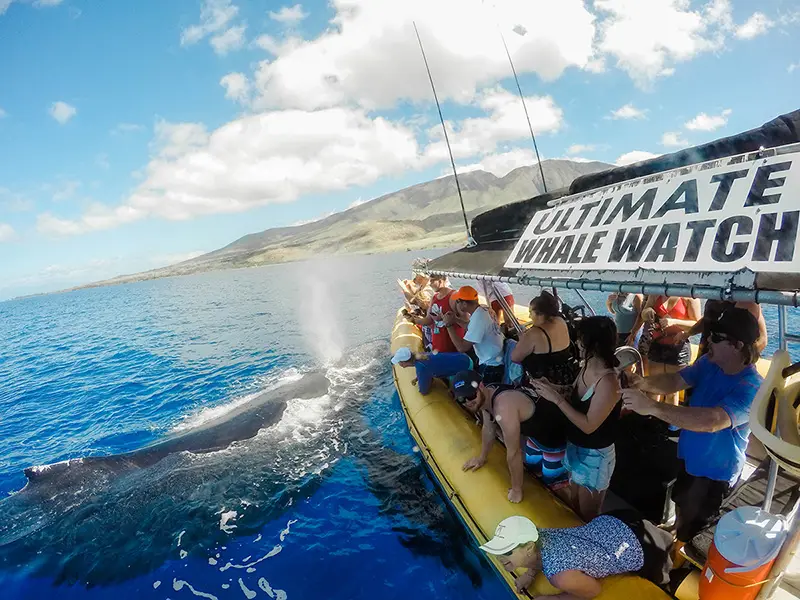
We’re Ultimate Whale Watch & Snorkel, and we’ve been taking guests out from Lahaina since 1982. Our boats are small and sit low to the water, so every seat is close to the action. Every trip has marine naturalist guides on board, and every ticket supports active marine research and whale entanglement response.
In whale season (from December 1, peak February and March)
- 2-hour whale watch: our most popular trip, sunrise to sunset.
- 1.5-hour whale watch: sunrise and sunset only.
- VIP whale watch: limited to 12 guests.
- Luxe whale watch: just 6 guests aboard Wahine Moana, from Lahaina Harbor.
- Whale watch and reef snorkel combo: 3.5 to 4 hours with one snorkel stop.
Each whale watch has a hydrophone, so you can listen to the males sing underwater. And we guarantee you will see a whale, or you go again for free.
Any time of year: Lanai snorkel and dolphin trips
- Dolphin Adventure & Lanai Snorkel: 4 hours, 2 snorkel stops, snacks.
- Deluxe Dolphin Adventure & Lanai Snorkel: 6 hours, 3 snorkel stops, lunch.
We see dolphins on about 9 of 10 snorkel trips, along with sea turtles, colorful reef fish, rays and octopus. Gear, flotation and instruction are included, and a guide snorkels in the water with you, so these trips work well for beginners. In whale season, whale watching comes free on the way.
See whale watch tours and book See snorkel tours and book
Most trips leave from Mala Boat Ramp, 1229 Front St., Lahaina. The Luxe 6-guest whale watch leaves from Lahaina Harbor. Guests must be 4 or older. Want the boat to yourselves? See private charters. Questions: (808) 667-5678.
West Maui and Lahaina
The West Maui mountains block much of the trade wind, so the ocean off Lahaina is calmer on most days. The shallow channel between Maui, Lanai, Kahoʻolawe and Molokai is one of the main places in Hawaii where humpback whales mate, give birth and raise their calves. It’s why we’ve been based here for more than 40 years.
Visiting Lahaina with respect
On August 8, 2023, a wildfire destroyed most of historic Lahaina and took 102 lives. Many of our neighbors lost their homes, and rebuilding will take years. Front Street reopened to traffic on August 1, 2026, but most of the town is still empty lots, and some side streets are still closed.
Lahaina is a community that is rebuilding, not a sightseeing stop. If you’re staying on the West side or joining one of our tours:
- Follow posted signs and closures, and stay out of fenced areas and off private property.
- Please don’t stop to photograph the burned lots.
- Drive slowly and be patient: people here are working and rebuilding.
- Spend your money with local, Lahaina-owned businesses that have reopened.
Things to do on the West side
- Turtles at Mala Wharf. The old pier next to our boat ramp is a favorite resting spot for honu. Read Turtle-topia: Mala Wharf.
- Snorkel from the beach at Kāʻanapali and Nāpili on calm mornings. Our list of favorite snorkel spots on Maui has more.
- Whale watching from shore on the coastal pullouts on the Honoapiʻilani Highway in season. Pull fully off the road, and never stop in a traffic lane.
- Honolua Bay is a Marine Life Conservation District with great summer snorkeling: take nothing, and park only along the highway. Stay out in winter, when big surf makes it dangerous.
Road to Hana
The Hana Highway winds along Maui’s wet northeast coast through rainforest, past waterfalls and over one-lane bridges. The Hawaii Tourism Authority puts it at 52 miles from Kahului, with about 620 curves and 59 bridges. Without stops it takes 2 to 4 hours one way. It is a day trip, not a race, and the drive itself is the attraction.
Best stops
- Twin Falls, an easy early stop on a private farm that charges for parking.
- Garden of Eden Arboretum, a privately run botanical garden with ocean views.
- Kaumahina State Wayside, a state rest stop with views down the coast to Keʻanae.
- Keʻanae Peninsula, black lava shoreline, crashing surf and taro patches. Stay on the road and respect the homes here.
- Puaʻa Kaʻa State Wayside, small waterfalls and pools right by the road.
- Waiʻānapanapa State Park, the black sand beach, sea caves and coastal trail. Visitors need an entry and parking reservation from gostateparks.hawaii.gov (no same-day bookings). Open 7 a.m. to 6 p.m. There’s no lifeguard, so admire the surf from the sand.
- Hāna town, and the beaches nearby. Hāna Bay has a lifeguard.
- Kīpahulu District of Haleakalā National Park, a short drive past Hāna. The Pīpīwai Trail is 4 miles round trip with 800 feet of climbing, through a bamboo forest to the 400-foot Waimoku Falls. The Pools of ʻOheʻo are closed to swimming; see them from the short Kūloa Point Trail. Your Haleakalā entrance pass covers this district.
Timing, safety and respect
- Start early. Leave by 7 or 8 a.m., fill up with gas in Pāʻia, and bring water and snacks.
- Drive with aloha. At one-lane bridges, yield to oncoming cars and let a line of waiting cars cross. Pull over to let locals pass. Park only in marked stalls: cars sticking into the road can be towed.
- Use the official stops. State parks and county rest stops have parking and restrooms.
- Respect closed and private land. Many waterfalls you see on social media are on private property or closed for safety. If a gate or sign says kapu, no trespassing or closed, turn around. People live along this road.
- Stay out of streams in heavy rain. Flash floods and falling rock can come with no warning, even if it isn’t raining where you are.
- Check road conditions the day before. Storms and landslides closed parts of the highway in 2026, and there has been weekday roadwork near Kālepa Point beyond Hāna. Maui County posts road notices.
- Go back the way you came. Beyond Kīpahulu, the Piʻilani Highway around the south side is narrow, partly unpaved and often under repair. Check your rental car agreement before you even think about it.
Haleakalā National Park
Haleakalā rises 10,023 feet above the sea. From the summit you look down on the clouds and across a huge volcanic crater of red and black cinder.
- Sunrise needs a reservation. Every vehicle entering between 3 and 7 a.m. needs a sunrise reservation from recreation.gov ($1 per vehicle), on top of the entrance fee. Reservations open 60 days ahead, a few more are released 2 days ahead at 7 a.m. Hawaii time, and they sell out. Bad weather doesn’t get you a refund. Check the current rules on the National Park Service sunrise page.
- Entrance fee: $30 per private vehicle, good for 3 days, and it covers the Kīpahulu District near Hāna too (current fees).
- Sunset and daytime need no reservation, only the entrance fee.
- Dress warm. The summit is about 30°F colder than the coast and can drop below freezing, and the wind makes it feel colder. Bring layers, a hat, gloves and a blanket.
- Fill up first. The park has no food, supplies or gas.
- Short walks: the first viewpoint on Keoneheʻeheʻe (Sliding Sands) Trail is a 0.5-mile round trip into the crater view. Going further, the climb back up takes about twice as long as the walk down, in thin air. Near the entrance, the Hosmer Grove loop is about half a mile.
- Take the altitude seriously. At 10,000 feet, altitude sickness is real. Walk slowly and turn back if you feel unwell.
- Look for nēnē, the Hawaiian goose, and the silversword plant. Drive slowly: nēnē and seabirds are killed by cars on the park road.
Upcountry Maui
The cooler green slopes of Haleakalā are Maui’s ranch and farm country. Combine them with a Haleakalā visit.
- Kula, farms and gardens with wide views over the central valley to the West Maui mountains.
- Makawao, a paniolo (Hawaiian cowboy) town with shops and galleries.
- Pāʻia, a laid-back surf town at the start of the Road to Hana. Nearby Hoʻokipa Beach is a famous spot to see honu resting on the sand. Give them space.
South Maui beaches and snorkeling
Kīhei, Wailea and Mākena have long sandy beaches and reef snorkeling on calm days. Kamaʻole Beach Parks I, II and III in Kīhei and Mākena have lifeguards (8 a.m. to 4:45 p.m.); Wailea’s beaches do not.
- Mākena State Park (Big Beach), one of Maui’s biggest and most beautiful beaches. The state warns that its shore break can be very dangerous: watch the waves before you go in, and swim near the lifeguard. Visitors pay for parking and entry.
- Reef snorkeling at the rocky points between beaches in Wailea and Mākena, often with honu.
- ʻĀhihi-Kīnaʻu Natural Area Reserve, lava fields and protected reef past Mākena. Open 5:30 a.m. to 7:30 p.m. with paid parking (card only), and the anchialine pools are closed. Check the state’s reserve page before you go.
- Molokini, the crescent crater offshore, is a Marine Life Conservation District reached only by boat. The islet itself is a seabird sanctuary.
Read more in the best places for snorkeling in Maui and boat vs. beach snorkeling.
Central Maui and ʻĪao Valley
ʻĪao Valley State Monument is a short drive from Wailuku. A paved path leads to a view of the ʻĪao Needle, a green peak that rises from the valley floor. The valley is sacred ground in Hawaiian history, so stay on the paths. Visitors need a reservation from gostateparks.hawaii.gov (up to 30 days ahead) and pay for entry and parking. It’s open 7 a.m. to 6 p.m., but it has had short maintenance closures in 2026, so check the state park page first.
Maui wildlife and how to watch it
Humpback whales (koholā)
Each winter thousands of humpbacks, roughly half of the North Pacific population, come to Hawaii from Alaska to mate, give birth and nurse their calves. You may see them breach, slap their tails and fins, or rest at the surface with a calf. By law, boats, swimmers and drones must stay 100 yards away, and aircraft 1,000 feet. Sometimes a whale chooses to come closer, and that’s a moment you won’t forget. Learn more in our humpback whale fun facts and whale behavior guide.
Green sea turtles (honu)
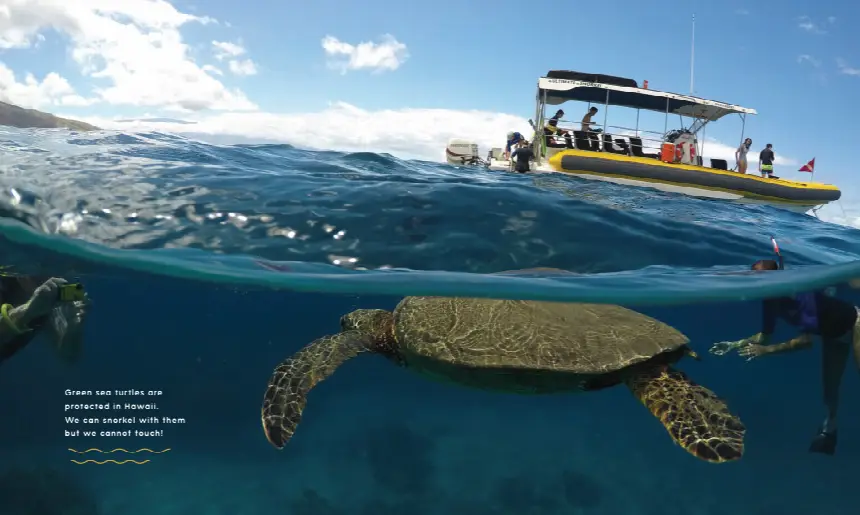
Honu live around Maui all year. You’ll see them grazing on reefs, surfacing for air and resting on beaches. They are protected: NOAA asks you to stay at least 10 feet away, never touch, chase or feed them, and never block their way to the surface. Read our turtle dos and don’ts and where to see turtles in Maui.
Dolphins
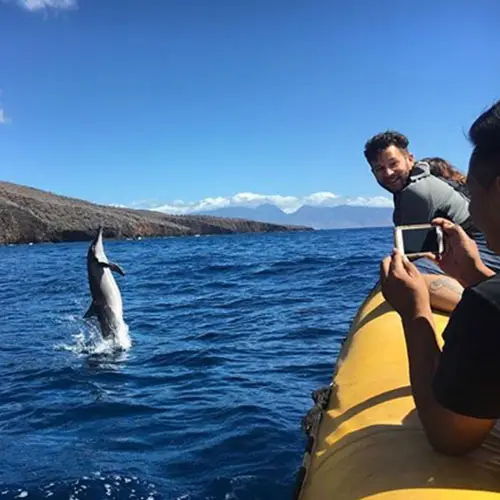
Spinner dolphins rest in calm bays during the day, and bottlenose and spotted dolphins also live around Maui and Lanai. We see dolphins on about 9 of 10 snorkel trips. Federal law bans swimming with spinner dolphins or approaching within 50 yards of them anywhere within 2 miles of shore, and NOAA asks for the same 50 yards for other dolphins. More in Dolphins in Maui.
Hawaiian monk seals
One of the most endangered seals in the world, found only in Hawaii. Now and then one hauls out to rest on a Maui beach. NOAA asks you to stay at least 50 feet away, and 150 feet from a mother and pup. Keep dogs away, and never get between a seal and the water. See NOAA’s wildlife viewing guidelines.
Reef fish
Maui’s reefs are full of yellow tang, butterflyfish, parrotfish, Moorish idols and the state fish, the humuhumunukunukuāpuaʻa. Many reef fish in Hawaii are found nowhere else in the world. Our guide to Maui ocean life covers more.
Ocean safety and reef-safe sunscreen
- When in doubt, don’t go out. That’s our rule on every trip. Conditions change fast, so swim at beaches with lifeguards when you can and ask them about the day. On Maui, lifeguards work 8 a.m. to 4:45 p.m.
- Know the seasons. From about November to April, big surf hits the north- and west-facing shores. Summer swells reach the south shore. Watch the water for a few minutes before you go in.
- Never turn your back on the ocean, and stay off wet rocks near the surf.
- Snorkel with a buddy, use a float, and skip full-face snorkel masks. Read our beginner’s guide to snorkeling.
- Use mineral sunscreen. Since 2021, Hawaii has banned the sale of sunscreens with oxybenzone and octinoxate to protect coral reefs, and since October 2022 Maui County has gone further and allows only mineral sunscreens. Look for non-nano zinc oxide or titanium dioxide, or cover up with a rash guard and hat. We provide reef-safe sunscreen on every tour.
- Don’t stand on coral, and don’t touch or feed marine life.
What to pack
- Mineral sunscreen, a hat, sunglasses and a rash guard
- Swimsuit and a light towel
- Warm layers, a hat and gloves for the Haleakalā summit
- A light rain jacket for the Road to Hana
- Water shoes or sturdy sandals, and walking shoes for trails
- A reusable water bottle and snacks for long drives
- A camera, ideally waterproof (a GoPro on a selfie stick is our favorite tip)
- Binoculars for whale watching from shore
- Motion-sickness medicine if you’re prone to it (ask your doctor or pharmacist)
Maui trip FAQ
Is 5 days enough for Maui?
Yes. Five days lets you see the highlights at a relaxed pace: a day on the water with whales or turtles, Haleakalā, the Road to Hana, a beach and snorkel day, and time to rest. With fewer days, choose between the Road to Hana and Haleakalā rather than rushing both.
When is whale season on Maui?
Humpback whales arrive in winter. Our whale watch tours start on December 1, and the most whales are here in February and March. The whales slowly head back north in spring.
Do I need a reservation for the Haleakalā sunrise?
Yes. Every vehicle entering Haleakalā National Park between 3 and 7 a.m. needs a sunrise reservation from recreation.gov ($1 per vehicle), plus the park entrance fee. Reservations open 60 days ahead and sell out. Sunset needs no reservation. Check the National Park Service website for the current rules before you go.
Do I need a reservation for the Road to Hana?
Not for the road itself. Visitors do need an entry and parking reservation for Waiʻānapanapa State Park, the black sand beach near Hāna, from gostateparks.hawaii.gov. Bookings open 30 days ahead and can’t be made on the day.
Where is the best place to see sea turtles on Maui?
Honu live all around Maui. Good places are the reefs off the West side, including Mala Wharf in Lahaina, the rocky points in South Maui, and Hoʻokipa beach on the North Shore, where they rest on the sand in the afternoon. On our Lanai snorkel trips we see them on most days. Stay at least 10 feet away and never touch them.
Can I visit Lahaina?
Yes, West Maui is open to visitors, and Front Street reopened to traffic on August 1, 2026. Much of historic Lahaina was destroyed in the August 2023 wildfire and is still being rebuilt, so please follow posted closures, stay out of fenced areas, don’t photograph the burned lots, and support local businesses that have reopened. Our tours leave from Mala Boat Ramp and Lahaina Harbor.
Where do Ultimate Whale Watch tours leave from?
From Lahaina. Most trips leave from Mala Boat Ramp, 1229 Front St. The Luxe 6-guest whale watch on Wahine Moana leaves from Lahaina Harbor. Your booking shows which one is yours.
What sunscreen can I use in Maui?
Use a mineral sunscreen with non-nano zinc oxide or titanium dioxide. Hawaii bans the sale of sunscreens with oxybenzone and octinoxate, and Maui County allows only mineral sunscreens. We provide reef-safe sunscreen on every tour.
Make the whales and turtles part of your trip
A morning on the water is the part of Maui most guests talk about for years: a mother humpback and her calf at the surface, a whale singing through the hydrophone, a honu gliding under you on a Lanai reef. Book it early in your trip, and we’ll take care of the rest.
More Maui reading
- Maui whale season: the best months to see whales
- The best place to see whales in Maui
- Whale watching guide for whale lovers in Maui
- Snorkeling with sea turtles in Maui
- What is the water temperature in Maui?
- Protecting the coral reef in Maui
- Our guest FAQ
Rules, fees and closures change. We checked the facts in this guide against official sources in November 2026; always confirm on the official sites linked above before you go.